 Thermal Management Research Center
Development and Modification of Liquid Metal (e.g., Galinstan) Thermal Interface Materials
Research Content
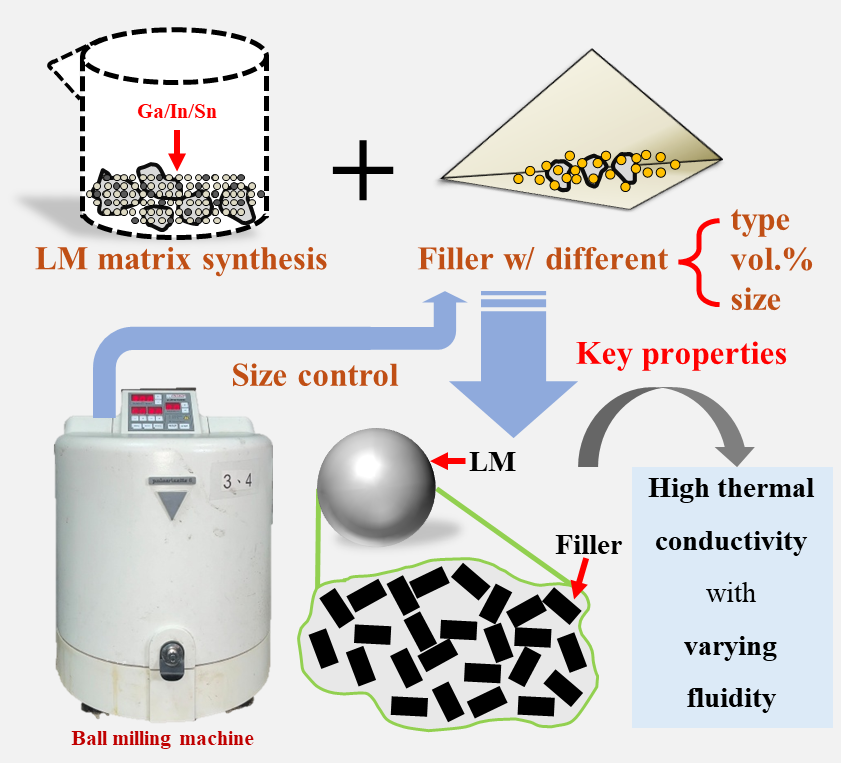
The main function of Thermal Interface Materials (TIMs) is to fill the gaps between various heat transfer components, reducing contact thermal resistance. Since typical interface materials are thin and have lower thermal resistance compared to other heat transfer components, their thermal conductivity does not significantly impact overall heat transfer performance when chip heat generation is low; thus, silicone mixed with metal powders is often used. However, as heat exchangers transition from direct air cooling to liquid cooling in recent years, thermal resistance drops to less than 1% of direct air-cooled fins. Consequently, the thermal conductivity of TIMs has become crucial. This research utilizes liquid metal (LM) based on a ternary alloy of gallium, indium, and tin (Galinstan) as a matrix. It combines fluidity, high thermal conductivity, and high volumetric latent heat of phase change. Its heat transfer coefficient is far superior to existing silicone-based TIMs, bringing disruptive changes to advanced cooling technologies.