 Thermal Management Research Center
Design of Single-Phase and Two-Phase Heat Exchangers
Research Content
The purpose of a heat exchanger is to transfer the heat generated by each die to the atmosphere. Based on the heat transfer mechanism, it can be divided into direct air cooling or liquid cooling. The heat exchanger required for direct air cooling is a heat sink fin, mainly used for cooling low-power, low-heat chips. Liquid cooling, on the other hand, uses cold plates to transfer the heat generated by the chip to the outside of the server via single-phase liquid or two-phase evaporation, and then dissipates it to the atmosphere through a larger external radiator. This is suitable for medium and high-power chip cooling. In recent years, due to the rapid growth of computing speed and a sharp increase in heat generation, the industry has begun to adopt single-phase liquid cooling. For instance, nVIDIA specified liquid cooling as the standard thermal specification starting from the H200 chip released in 2023. It is expected that as chip heat generation continues to increase, two-phase evaporative cooling will become an essential option.
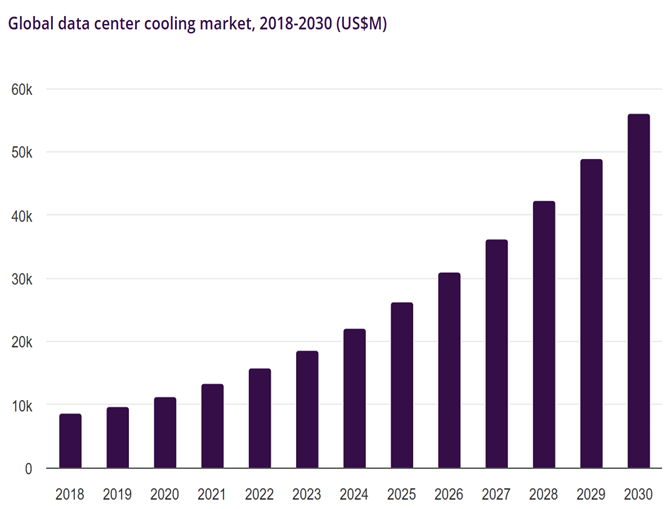
(Grand View Research, Market analysis report, 2024)